Welfare Economics in the Classical Period
Welfare questions emerge at the beginning of political economy, in enlightenment thought. Political economy could be said to have begun with Quesnay, Mirabeau, and the Physiocrats, known in their time as “les économistes”. His book is titled Physiocratie, ou Constitution Naturelle du Gouvernement le Plus Advantageux au Genre Humain. Published in 1768.
Adam Smith may be the first writer to claim that the goals of the state is the welfare of its people.
No society can surely be flourishing and happy, of which the far greater part of the members are poor and miserable… A. Smith. An Inquiry into the Nature and Causes of the Wealth of Nations. 1776. Bk I Ch I
Nonetheless, an analytical system of welfare economics does not begin to emerge until the middle of the 19th century. Many classical writers — Ricardo, for example — were just not that interested in ethical questions. Their concern was much more with the workings of the economy than an assessment of its outcomes. Among those who had an interest there was sharp disagreement. Smith wrote,
The real price of every thing, what every thing really costs to the man who wants to acquire it, is the toil and trouble of acquiring it. Weath of Nations Bk. 1 Ch. 3.
The French thought differently about this. Say responds to Smith thus:
Il attribue au seul travail de l'homme le pouvoir de produire des valeurs. C'est une erreur.JB Say, Traité d'Économie Politique 1814 [1803]. Discours Préliminaire. “He attributes to human work alone the power to produce value. This is a mistake.”
In fact, Say is a transitional figure in the transition from classical to neoclassical thought. He understood that in determining market value, demand played a role alongside supply.
Or, cette qualité qui fait qu'une chose a de la valeur, il est évident que c'est son utilité. Les hommes n'attachent du prix qu'aux choses qui peuvent servir a leur usage; c'est en vertu de cette qualité, qu'ils consentent a faire un sacrifice pour les achater; car on ne donne rien pour se procurer ce qui n'est bon a rien.JB Say, Cours Complet d'Économie Politique Pratique 1828. I.I.III, 163. “Now, this quality which makes a thing valuable, is evidently its utility. Men only attach value to things which can serve their use; it is by virtue of this quality, that they consent to make a sacrifice to buy them; for one gives nothing to obtain that which is good for nothing.”
Utilitarianism
Utilitarianism has antecedants in the ancient world. Some see precursors in the thought of Aristotle. The Epicurians, one of the three major schools of Hellenistic philosophy, taught hedonism, the idea that pleasure is the ultimate good and pain the ultimate bad. Nonetheless, classical utilitarianism is a product of 18th and 19th century Britain.
The first classical utilitarian is (arguably) the Scottish enlightenment philosopher Frances Hutcheson. He wrote,
In the same manner, the moral evil, or vice, is as the degree of misery, and number of sufferers; so that, that action is best, which procures the greatest happiness for the greatest numbers; and that, worst, which, in like manner, occasions, misery.Frances Hutcheson. Inquiry Concerning the Original of Our Ideas of Virtue or Moral Good. But utilitarianiam has a long history. The dictum of the greatest number seems first to have appeared in the writings of Leibniz around 1700. See, Joachim Hruska. 1991. “The greatest happiness principle and other early German anticipations of utilitarian theory”. Utilitas 3(2) pp. 165–177.
Utilitarianism, begins with Jeremy Bentham, John Stuart Mill, and later, and Henry Sidgwick.
Until Walras the French never come up with a clear statement of a marginal utility doctrine, but they were quicker to see the implications of utility for demand than were the English. This is particularly true of Dupuit, the inventor of consumer surplus.
Cournot was the first to use demand in an analytic model, but Dupuit was the first to connect demand with utility. He claimed that inverse demand was downward sloping and convex (the latter because more people could afford goods at lower prices). Consequently, price measured the utility of the last unit sold, and so the total utility of all that was sold must be the sum of successive prices as one moves up the demand curve, hence the area under inverse demand; that is, consumer surplus. A. A. Cournot. 1837. Recherches sur les Principes Mathématiques de la Théorie des Richesses; and J. Dupuit. 1844. “De la mesure de l'utilité des travaux publics”. Annales des ponts et chaussées: Partie technique. He did not, however, develop a general theory of demand as a consequence of optimization.
Bentham did not have a particularly precise view of what utility is. For instance, is it about acts and intentions, or is it a property of objects? He write in An Introduction to the Principles of Morals and Legislation, 1789:
By the principle of utility is meant that principle which approves or disapproves of every action whatsoever, according to the tendency which it appears to have to augment or diminish the happiness of the party whose interest is in question: or, what is the same thing in other words, to promote or to oppose that happiness. I say of every action whatsoever; and therefore not only of every action of a private individual, but of every measure of government.
and
By utility is meant that property in any object, whereby it tends to produce benefit, advantage, pleasure, good, or happiness (all this in the present case comes to the same thing), or (what comes again to the same thing) to prevent the happening of mischief, pain, evil, or unhappiness to the party whose interest is considered…
To some degree, both views are present in neoclassical economic thought.
For ordinary purposes economic things can best be described as economic, just as blue things can best be described as blue. But if we must have a second-best description for the benefit of those who doubt whether they know what is meant by the term economic, I think we must fall back on “having to do with the more material side of human happiness,” or more shortly, “having to do with material welfare.”E. Cannan. Wealth: A Brief Explanation of the Causes of Economic Welfare. (1922 [1914]) Ch.1.
And for the other side, a more famous quotation:
Here, then, is the unity of subject of Economic Science, the forms assumed by human behaviour in disposing of scarce means. … Economics is the science which studies human behaviour as a relationship between ends and scarce means which have alternative uses.L. Robbins. An Essay on the Nature and Significance of Economic Science. (1932) p.4.
Bentham and Mill saw utility as a psychological explaination for behavior and normatively as a standard for morality. Pleasure and pain – utility – are commensense concepts, hence measurable. Practical application of utility measurement leads to maximizing the greatest good for the greatest number. They took utility to be a practical concept that could be observed and measured by a properly qualified class of people.
Utility analysis appeared in economics as a fundamental primitive in the work of William Stanley Jevons, Carl Menger and Leon Walras. Jevons first published in 1862, and his principle theoretical contribution came a decade later.W. S. Jevons. 1871. Theory of Political Economy. Jevons wanted to understand the process of price formation in markets. In this he was much closer to Edgeworth and to Menger than to Walras, who jumped to the existence of equilibrium in well-organized markets.
Jevons
Jevons is a Benthamite. In his first sentence appears the phrase, “we must undoubtedly accept what Bentham has laid down upon this subject.” And, “Pleasure and pain are undoubtedly the ultimate objects of the Calculus of Economics.”Ibid, Ch. III. Jevons is clear about the subjective nature of utility. “It is better described as a circumstance of things arising out of their relations to man's requirements.”Ibid. Ch. III. He distinguishes the total utility from the degree of utility, by which he means marginal utility. And finally, he identifies diminishing marginal utility as an empirical regularity and understands its importance for solving optimization problems.
Jevons understanding of utility is apparent in his nuanced discussion of value. In discussing the diamond-water pardox, he writes of three uses of the word value: value in the use of a commodity, the intensity of desire for a commodity, the esteem in which we hold it, and the value of a commodity in exchange for other commodities. He summarizes:
- Value in use = total utility;
- Esteem = final degree of utility [marginal utility];
- Purchasing power = ratio of exchange.
Jevons' analysis of exchange is not distant from Edgeworth but quite different from Walras. Jevons makes no use of demand, and does not discuss price ratios and budget lines. Instead he imagines a process of exchange. The point of his theory is to derive the proposition:
The ratio of exchange of any two commodities will be inversely as the final degrees of utility of the quantities of commodity available for consumption after the exchange is completed.Ibid. p.95–6.
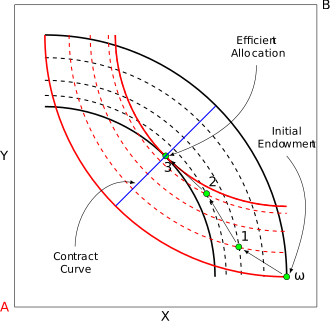
The process is pictured, only somewhat ironically, in an Edgeworth box. The initial endowments of traders A and B is at $\omega$. They exchange some quantities of goods; suppose $A$ gives up $\Delta x_1$ units of X for $\Delta y_1$ units of Y. They are now at allocation 1, in which they are both better off. Trader A now has consumption bundle $\omega^A+(-\Delta x_1,\Delta y_1)$ and trader B has $\omega^B+(\Delta x_1,-\Delta y_1)$. The process of exchange continues to allocation 2 alnd ultimately to allocation 3. At allocation 3 there is no trade which will improve both traders, and so the process stops. Jevons saw this process as incremental, going through several rounds to its ultimate conclusion. As Jevons put it:
Exchange will thus go on till each party has obtained all the benefit that is possible, and loss of utility will result if more were exchanged. Both parties, then, rest in satisfaction and equilibrium, and the degrees of utility have come to their level, as it were.Ibid. p.97.
The trading process could terminate anywhere along the contract curve. The arguments made so far do not get trading for all pairs of individuals to end at the same point on the contract curve,to establish final market price ratios. This is the point where Jevons gets very murky. Without going into detail, Jevons tried to assimilate the individual to the social by considering trading groups. And here he makes little progress. But Jevons' contribution is nonetheless substantial. His fundamental notion is not market but exchange. He does not require price-taking behavior, nor does he require the technical apparatus of supply and demand. Notice too that individuals are not optimizing moment by moment. They are improving trade-by-trade, and the end result is the yet-to-be-named contract curve. Jevons is on a very different path than Walras and Marshall. Jevons' research program is continued by Edgeworth, who pushes the idea of trading processes farther by moving from the individual to aggregates.
Edgeworth
Edgeworth is proudly utilitarian: “Of the Utilitarian calculus the central conception is Greatest Happiness, the greatest possible sum-total of pleasure summed through all time and over all sentience. ”F.Y. Edgeworth. 1881. Mathematical Psychics. p. vii. He goes on to write:
The application of mathematics to the world of the souol is countenanced by the hypothesis (agreeable to the general hypothesis that every psychical phenomenon is the concomitant, and in some sense the other side of a physical phenomenon), the particular hypothesis adopted in these pages, that Pleasure is the concomitant of Energy. Energy may be regarded as the central idea of Mathematical Physics; maximum energy the object of the principal investigatios in that science. By aid of this conception we reduce into scientific order physical phenomena, the complexity of which may be compared with the complexity which appears so formidable in Social Science.ibid. p. 9.
Edgeworth defines exact utilitarianism as entailing “the greatest quantity of happiness of sentients, exclusive of number and distribution — an end to which number and distribution are but means.”
No one in economic theory with the exception of Paul Samuelson is as motivated by physics as is Edgeworth.
Utility, as Professor Jevons says, has two dimensions, intensity and time. The unit in each dimension is the just perceivable increment. The implied equation to each other of each minimum sensibile is a first principle, incapable of proof.ibid. p. 7.
Problem.—To find $(\alpha)$ the distribution of means and $(\beta)$ of labor, the $(\gamma)$ quality and $(\delta)$ number of population, so that there may be the greatest possible happiness. … Greatest possible happiness is the greatest possible integral of the differential 'Number of enjoyers${}\times{}$duration of enjoyment${}\times{}$degree thereof '…ibid. p. 56–57.
and in a footnote to this passage, “The greatest possible value of $\int\int\int dp\,dn\,dt$ (where $dp$ corresponds to a just perceivable increment of pleasure, $dn$ to a sentient individual, $dt$ to an instant of time).”
Despite this physicophilia, Edgeworth made important contributions to the general methodology of marginal analyss and to the theory of price determination. Until Edgeworth, utility was attributed to a given quantity of each good, and the utility of a consumption bundle was the sum of the utilities of the quantities. Edgeworth demonstrated how to conduct marginal analysis without additive separability.Also, and independently, Rudolf Auspitz and Richard Lieben, Untersuchungen über die Theorie des Preises. Leipzig: Duncker & Humblot, 1889. This was not just a mathematical innovation. It moved the attribution of utility from goods per se to the commodity-wise more collective experience of consumption.Despite this innovation, Edgeworth was very much a classical utilitarian, believing that utility was nonetheless a physical quantity that could be measured. Beyond this, however, is his theory of contract and competition.
Edgeworth imagined a large number of individuals trading with one another, contracting and recontracting as they pursue their self-interest. His concern is with the “determinacy of contract” Settlement is not uniquely determined, but he identified the locus of points along which settlement may take place, and called it the contract curve.
His view of trading is quite rich. “…every agent is actuated only by self interest” and may act “…without, or with, the consent of others affected by his actions. …the first species of action may be called war; the second, contract.” “…economic competition …is both, pax or pact between contractors during contract, war, when some of the contractors without consent of the others recontract.” “The field of competition …consists of all the individuals who are willing and able to recontract about the articles under consideration.” An agent may contract or “recontract with any out of an indefinite number…without the consent being required of, any third party…”ibid. pp. 16–7.
He provides several arguments that each lead to the following conclusion:
That contract in a state of perfect competition is determined by demand and supply is generally accepted, but is hardly to be understood without mathematics. … The familiar pair of equations is deduced by the present writer from the first principle: Equilibrium is attained when existing contracts can neither be varied without recontract with the consent of the existing parties, nor by recontrct within the field of competition. ibid. pp. 30–1.
That is, with perfect competition equilibrium is attained when
a contract is in the core! It was more than eighty years before
Debreu and Scarf demonstrated the plausibility of this claim,
and another eleven years before Werner Hildenbrand's general
treatment.G. Debreu
and H. Scarf. 1963. “A limit theorem on the core of an
economy”.
Pareto
Vilfredo Pareto is the unsung hero of neoclassical welfare economics. Hero, obvious; but unsung? Neoclassical welfare economics is largely a product of the interwar and immediate postwar years with the exception of Pareto's development of what we now call Pareto optimality, introduced in two 1894 articles. The idea was independendly rediscovered in the work of Lange, Lerner, and Arrow, and Pareto's priority was first significantly recognized only in 1950 in I. M. D. Little's A Critique of Welfare Economics.Pareto, V. “Teoria matematica dei cambi forestieri”. Giornale degli Economisti [2] 8 (February 1894), 142–173; and “Il massimo di utilità dato dalla libera concorrenza” Giornale degli Economisti [2] 9 (July 1894), 48–66. It is not true that Pareto's ideas were entirely unknown in the Anglo-American sphere, but they were obscure, and his originality was unappreciated. For example, in 1938 Abram Bergson wrote of the first welfare theorem that, out of equilibrium (that is, where the first order conditions fail, “…Pareto, like Marshall, shows in an early section of his work that, otherwise, it is possible to increase the Ophélimité of some individuals without that of any others being decreased.“A reformulation of certain aspects of welfare economics.” Quarterly Journal of Economics 52 p. 325.
But this is hardly the extent of Anglo-American neglect of Pareto. The Kaldor-Hicks compensation principle first appeared in the second of Pareto's cited 1894 articles. Furthermore, the idea of the Bergson-Samuelson social welfare function is first discussed by Pareto in 1913.Pareto, V. “Il massimo di utilit`a per una collettività in Sociologia”. Giornale degli Economisti e Rivista di Statistica [3], 46 (April 1913), 337– 341.
Perhaps even more important that Pareto optimality is the idea that welfare economics can be conducted without any requirement that marginal utility be measurable, that is, cardinal. He writes, “We cannot compare or add these quantities [MU of different individuals], because we do not know the relationship between the units in which they are expressed.”Cours d'Economie Politique TK.
Interestingly, Pareto posed the welfare optimization problem in the context of a socialist state wherein a Minister of Production chooses production coefficients and a Minister of Justice who allocates output so as to achieve maximal utility for each citizen. Prices are market-determined, but production is owned by the state and the government may run a budget surplus. It is an exercise to check that, subject to a fixed surplus, which amounts to a lump-sum tax, the usual first-order analysis still applies.
Embeddedness is a sociological expression of the idea that economic activity is shaped by and shapes the larger expanse of social life. Although attributed to the Austrian economic historian and sociologist Karl Polanyi, this idea drew Pareto to sociology and led to his writing what some regard as his best-known work, Trattato di Socologia Generale1916, revised French translation 1917, published in English as The Mind and Society, 1935. Of this intellectual move he wrote,
A number of economists today are aware that the results of their science are more or less at variance with concrete fact, and are alive to the necessity of perfecting it. They go wrong, rather, in their choice of means to that end. They try obstinatelyto get from their science alone the materials they know are needed for a closer approximation to fact; whereas they should resort to other sciences and to into them thoroughly — not just incidentally — for their bearing on a given economic problem. Many economists are paying no attention to such interrelations, for mastery of them is a long and fatiguing task requiring an extensive knowledge of facts;whereas anyone with a little imagination, a pen, and a few reams of paper can relieve himself of a chat on “principles.”ibid. IV p. 1413.Neoclassical Welfare Economics
Jump ahead: The Bentham-Mill approach culminates in Pigou. His concern was economic welfare, “that part of welfare that can be brought, directly or indirectly, into relation with the measuring rod of money.” He did not think utility analysis applied to all things; only those goods that had material value. Art, for instance, was not subject to a utilitarian analysis. In this he differed from Robbins and the later neoclassicists.
Pigou asked, when does laissez-faire not result in maximum welfare? In answering this question he gave us externalities and public goods.
… one person A, in the course of rendering some service, for which payment is made, to a second person B, incidentally also renders services or disservices to other persons C, D and E, of such a sort that technical considerations prevent payment being exacted from the benefited parties or compensation being forced on behalf of the injured parties.A. C. Pigou. The Economics of Welfare. (1920)