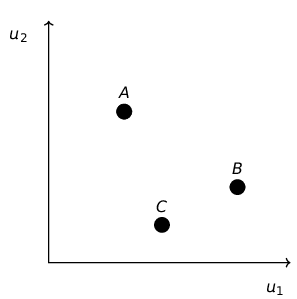
This two-person example illustrated the force of the axioms. $X=R^2_+$. Choose $A$, $B$ and $C$ as in the figure. Suppose the social preference is $A\sim B$. Ordinality implies that $A\sim C$. Transitivity implies that $B\sim C$, which violates Pareto.
If the social preference is $A\succ B$, then whenever $u_2(x)>u_2(y)$, $x\succ y$, either because we are as in the picture, or if $u_1(x)>u_1(y)$, because of the Pareto axiom. Therefore $2$ is a dictator. If $B\succ A$ then, for the same reason, 1 is a dictator.
Ordinality is a consequence of IIA. Suppose the datum for the SWF is a vector of utilities. IIA requires that if the magnitudes of utility differences for $A$ versus $B$ are changed but not the signs of the differences, then the social ranking does not change.